Overview
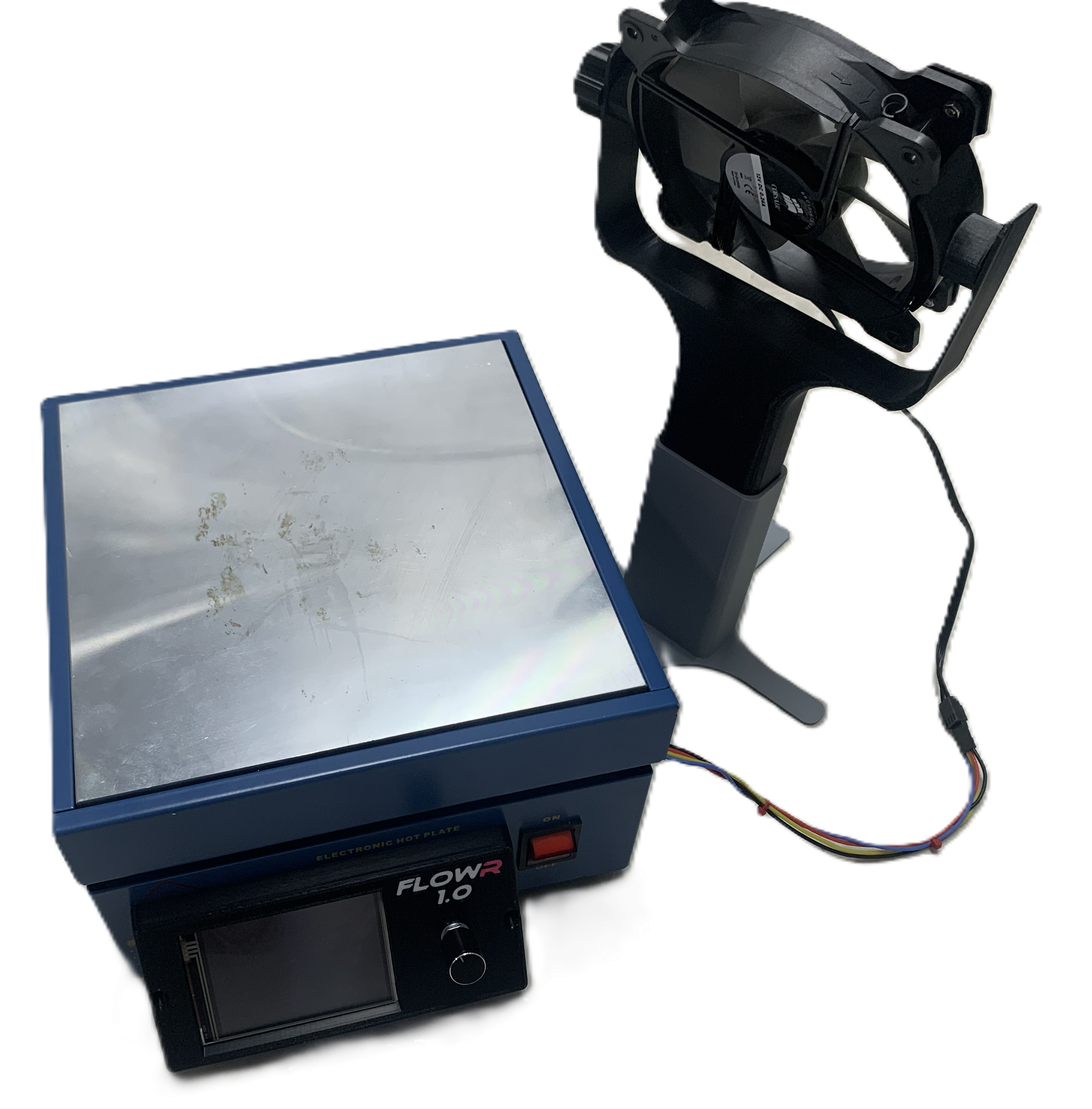
This project converts an off-the-shelf hotplate, which has only manual temperature setting, to automatic operation. Once modified, the hotplate can be configured to follow the temperature profile (temperature over time) of a solder paste. This allows you to produce custom PCB's with SMD components in a more repeatable fashion than can be obtained with hand soldering or manual control of the hotplate.
And, anyway, it's a lot more fun! 
History
Starting in April 2022, Curious Scientist published a series of YouTube videos detailing the construction of an Automated Reflow Hotplate. The project was entirely DIY and assembled from piece parts. In November 2024, he published an update to the project with refinements to both the hardware and software.
You can find more information on this project and a link to the 2024 update video here:
Curious Scientist's Blog
In February 2025, PaulV documented his own approach to building an automated reflow hotplate. His design was based on Curious Scientist's software but he built his hardware by modifying a commercial hotplate.
You can find PaulV's design journey on his blog here:
PaulV's Blog
I came across PaulV's blog early in 2026. Since I already had a commercial hotplate which I had been using for some time and I was tired of manually adjusting the temperature to reflow PCB's, it seemed like the perfect solution to my problem.
I decided to implement some new features and, to make that process easier, I also decided to restructure the code to follow the MVC pattern.
List of the more significant enhancements implemented in this version:
- The settings are persisted to EEPROM (an idea from PaulV's blog)
- The solder paste profile names can be modified using the GUI
- Heating and cooling are controlled using a PID algorithm
- In order to maintain the target temperature, there is support for switching over between heating and cooling, with a deadband to limit rapid switching
- There is a screen for tuning the PID controller
- There is (essentially) no time limit for the temperature vs time graph. When the graph reaches the right side of the screen, it wraps back around to the y-axis. The time labels on the x-axis are updated with the actual elapsed time as they are reached.
- There is support for firmware upgrades using the OTA feature of the ESP32 so that the hotplate housing does not need to be opened to perform updates
Licensing
Although I've done extensive work to restructure the code, the core of this version is still based principally on the ideas and source code by Curious Scientist. As such, this version of the code is shared with permission from Curious Scientist with the following limitation:
You may use the code for non-commercial purposes only. If you have plans for commercial use or want to charge money for it, please contact Curious Scientist via the contact form on his website: contact curiousscientist.tech